Fire Aviation reader Ryan Grothe recently photographed 2 Bell 412 EPX working a county wildland drill over a 2 day period in California.
County Wildland Fire Drill, San Marcos, May 2025. Photo Ryan Grothe
“May 6th through May 8th, numerous fire agencies in San Diego participated in the annual County Wildland drill. The drill was held in the city of San Marcos. There were three branches. Two of which focused on wildland hose lays and structure protection. The 3rd branch focused on communications and sandbox drills.
Two helicopters also participated in the drill. San Diego City Copter 2 and San Diego Sheriff’s Department Copter 11. Both of which are Bell 412EPX. This is the first year Copter 11 will be making water drops as it was purchased last year.”
County Wildland Fire Drill, San Marcos, May 2025. Photo Ryan Grothe
Thanks for sharing your photos Ryan.
County Wildland Fire Drill, San Marcos, May 2025. Photo Ryan Grothe
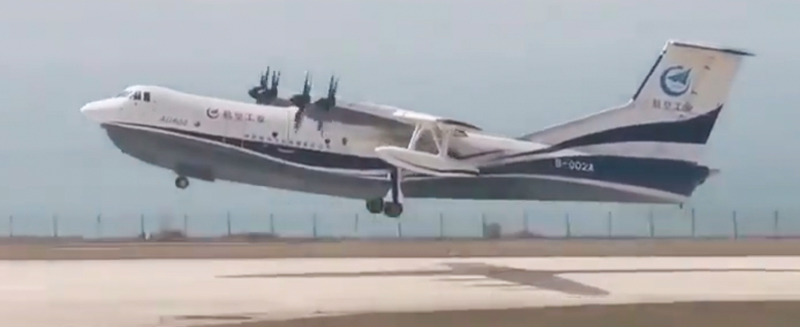
China’s media is reporting that a significant milestone for the AG600 large amphibious aircraft in having successfully completed all compliance flight tests in ground takeoff and landing in crosswind conditions.
Xinhau claims that the aircraft has now obtained its type certificate from the Civil Aviation Administration of China, marking its successful development and approval for market entry.
The aircraft has been developed specifically for fire and emergency rescue and response.
AG600. Photo: AVIC
The AG600 is promoted as the world’s largest civil amphibious aircraft in terms of takeoff weight, with a maximum of 60 tonnes. It is capable of carrying 12 tonnes of water for firefighting operations, with a cruising speed of 220 kilometres per hour (136 mph) and an operational range of 4500 kilometres (2796 miles)
Two AG600 aircraft recently underwent crosswind compliance flight tests at Xilinhot, in China’s Inner Mongolia Autonomous Region. The results of these tests met requirements, verifying the safety and reliability of the AG600 in strong crosswind conditions, AVIC is reported to have said.
The AG600 taxiing after its first flight December 2017.
“Its obtaining of the type certificate issued by the CAAC manifests that China can independently develop the world’s latest generation of large civil amphibious aircraft,” AG600 series aircraft chief designer Huang Lingcai told Xinhua.
“AG600 is a plane that can swim and a ship that can fly,” said Huang.
Its configuration consists of an integrated aircraft-shaped upper body and a ship-bottom-shaped lower body. On each side of its wing, there is a float over four meters long to prevent the aircraft from overturning sideways during its taxiing on the water surface.
AG600 has a minimum level flight speed of 220 km per hour, a minimum operating flight altitude of 30 to 50 meters above the treetops, and a designed service ceiling of 7,600 meters above sea level, according to data from the developer, the Aviation Industry Corporation of China. It has a length of 38.9 meters, a height of 11.7 meters, and a wingspan of 38.8 meters.
For a quick look at the engineering behind this aircraft, the developer has produced this short video.
A decades-long arrangement that shares firefighting resources between Australia, United States and Canada is under threat from increasingly overlapping fire seasons.
The two regions’ wildfire seasons historically peaked at opposite points of the year, making the partnership a no-brainer. Lengthening fire seasons in both regions, thanks to climate change, is placing more constraints on the resource-sharing partnership and shortening pre-season preparation windows.
A new report from researchers in Australia, Germany, and Switzerland used data from the Canadian Fire Weather Index and computed season length statistics to estimate how much the two seasons’ wildfire seasons will overlap over the next decades. The researchers found the overlap in western North America and eastern Australia has increased annually for generations, and the overlap’s increase is expected to quicken.
“We find that the overlap is projected to increase by ∼4 to ∼29 days annually by 2050,” the report said. “Our analysis shows that the length of fire weather season overlap between eastern Australia and western North America has increased by approximately one day per year since 1979.”
Posted by Defence Australia, @DeptDefence, December 2019.
The overlap between the two regions was most consistent during the end of the fire weather season in western North America and the beginning of the fire weather season in eastern Australia. Specifically, the years with greatest overlap were seen when the fire weather season in eastern Australia was longer than average, while high overlap still happened during times of average fire weather days in western North America.
Researchers were also concerned that Fire Weather Index values, or measurements of major drivers of fire weather like high temperature, low humidity, and wind speed, were also higher during years of greater overlap, heightening the risk of extreme fires.
“We argue that the changes in risks to firefighting cooperation come not only from a general increase in fire weather season overlap, but also from the increased probability of extreme fires,” the report said. “An increased probability of extreme fires … implies possible changes in the frequency of disasters that require an emergency response, for example, with an exchange of personnel as experienced in 2019–20 or 2023.”
As aerial firefighting continues to grow as an essential component of wildfire response in the United States, planners and policy makers must ensure that existing airport and air traffic control infrastructure can continue to provide safe and efficient services.
Researchers from George Mason University in Virginia broke down the current state of the nation’s aerial firefighting force. They looked at a range of data on the use of Very Large and Large Air Tankers (VLAT / LATs) during the 2024 fire season, helping policy-makers and aircraft planning authorities to make future projections of use.
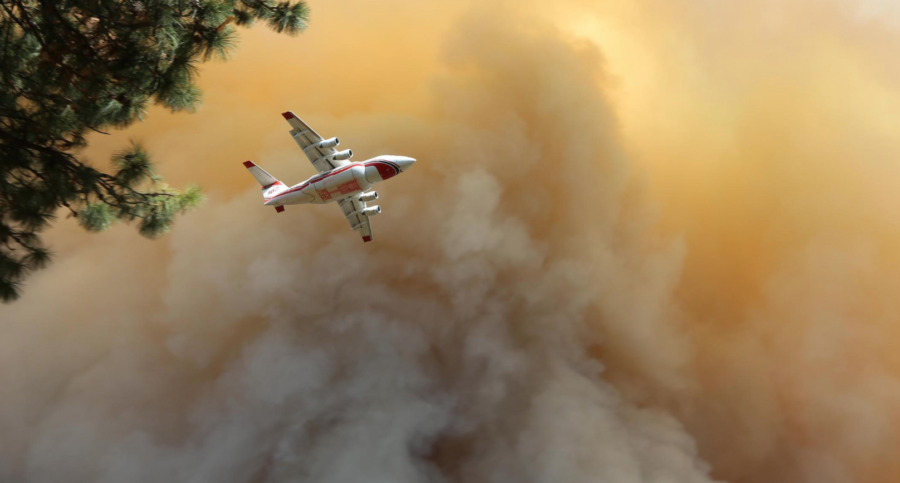
The United States Forest Service’s contracted 34 VLATs and LAT are aging, according to the report. The service’s oldest aircraft, the C-130s, are 57 years old since the date of manufacture while the newest aircraft, RJ85A, is 25 years old.
“Unlike commercial airliners, which benefit from large-scale manufacturing, the niche market for specifically designed aerial firefighting aircraft makes it difficult to achieve economies of scale, leading to high per-unit costs,” the report said. “Barring government subsidies or changes in the economics of aerial firefighting, a clean-sheet design of VLAT/LAT is unlikely.”
An airtanker makes a retardant drop over the Mosquito Fire after it jumped the American River and headed north toward Foresthill, California. 09-13-22 Inciweb photo.
A total of 11,219 retardant drops and reposition flights were performed over the course of the year. There were as many as 157 retardant drop flights in a single day across the fleet.
“Flights operated on 88% of the days with an average of 35 flights per day and a maximum of 200 flights per day,” the report said. “The number of flights per aircraft across the fleet was not uniform (average 288 flights, max 465 flights).”
The nation’s airports have also played an integral role in aerial firefighting, according to the report. More than 200 airports had VLAT and LAT departures over the course of 2024, but just 14 airports supported 50% of the departures. Redmond Airport in Oregon supported the most VLATs and LATs, with 6.4% of total flights.
Only two military airports assisted in VLAT and LAT departures, the rest of which were publicly owned airports that were part of the National Plan for Integrated Airports.
“Notably, in 2024, there were airports used east of the Rocky Mountains that have traditionally not supported aerial fire-fighting operations: Maine, Louisiana, Texas, Illinois, Ohio, Minnesota, Wisconsin, North Carolina, and South Carolina,” the report said.
The global firefighting aircraft market is predicted to grow at an annual rate of 6.3 per cent, according to a report by Allied Market Research.
The media release on the report states that the global firefighting aircraft industry size generated US$9.0 billion in 2022 and is anticipated to generate US$16.2 billion by 2032, for a CAGR (Compound Annual Growth Rate) of 6.3% from 2023 to 2032.
The report analyses the firefighting aircraft market by Aircraft Type (fixed-wing and rotorcraft), Tank Capacity (less than 10,000 litres, 10,000 to 30,000 litres, and more than 30,000 litres), Maximum Take off Weight (less than 8000 kg, 8000 to 30,000 kg, and more than 30,000 kg), and Range (less than 1000 km, 1,000 to 3000 km, and more than 3000 km).
The analysis of the firefighting aircraft market encompasses more than 15 countries, with a country-by-country breakdown in terms of value (US$ million) for the forecast period 2022-2032.
Allied Market Research (AMR) is a market research and business consulting wing of Allied Analytics LLP based in Wilmington, Delaware. Their research methodology includes combining data, professional opinions, and independent perspectives plus a comprehensive review of over 3700 product catalogues, annual reports, industry descriptions, and resources from industry leaders.
On the basis of region, North America held the highest market share in terms of revenue in 2022, accounting more than two-fifths of the firefighting aircraft market revenue and is expected to continue to dominate the market with the growing demand for firefighting aircraft due to the rise in the frequency and intensity of wildfires. However, the Asia-Pacific region is expected to witness the fastest CAGR of 7.8% from 2023 to 2032, owing to surge in the initiatives, funding, and support for firefighting agencies.
The firefighting aircraft industry has been adversely affected by the conflict between Russia and Ukraine, mainly because of supply chain disruptions involving essential raw materials. The supply chain of Russia, a significant manufacturer of titanium, a substance that is frequently used in the aerospace industry due to its strength and low weight, especially in widebody aircraft, has been impacted. This has created difficulties for the large aircraft manufacturers, such as Boeing and Airbus SE, to get a steady supply of titanium.
The report lists the following significant developments in the firefighting aircraft sector
Lockheed Martin, in August 2021, secured a contract from United Rotorcraft for five S-70 Black Hawk helicopters, for aerial firefighting operations.
Kaman Corporation, in October 2022, received a purchase agreement from North American Helicopter for a K-MAX medium-to-heavy lift helicopter.
Kaman Corporation announced its intention, in May 2022, to acquire Parker-Hannifin Corporation’s Aircraft Wheel and Brake division for $440 million.
Coulson Aviation, in August 2023, was selected for an indefinite delivery/indefinite-quantity contract, involving C-130H Hercules and Boeing 737 Fireliner aircraft, providing maintenance support.
Coulson Aviation secured a $16 million firefighting contract in November 2023, extending support for Southern California’s Quick Reaction Force throughout 2024, with potential extension into 2025.
In November 2023, Coulson Aviation secured a three-year firefighting contract with Corporación Nacional Forestal (CONAF) of Chile, deploying a C-130H Hercules Large AirTanker and a Citation 550 air attack lead plane.
In July 2022, Coulson Aviation introduced its latest aerial firefighting tanker, converted from a Boeing 737.
An Australian based research project is seeking to better understand how and why aircraft are used on wildfires and how effective that use is.
As part of the project, the Research Team of Matt Plucinski (CSIRO) and Owen Price (University of Wollongong) have developed a survey to help them understand strategic and tactical objectives involved in decision making with respect to the use of aerial firefighting assets.
The survey aims to capture expertise and opinion regarding objective setting, tactical response and resource selection for aerial firefighting. It is focused on aircraft use in firebombing roles (i.e. dropping suppressants and retardants).
Note that the survey may take up to an hour to complete, as the research team is trying to cover a wide range of topics, so it may be best attempted when respondents have time available. It is possible to start the survey and come back to it. Responses are recorded as you go, so you can return later (within a week of starting) to complete if using the same computer. It is best undertaken on a computer, as many questions require text responses.
The team is also looking for case studies from recent Australian fires where they are able to match up fire progression data to the ARENA database and talk to air attack supervisors about objectives and tactics.
If you have any suggestions for fires that you think might make good examples, please reach out to Matt Plucinski at ma************@***ro.au.
It’s been over a month since President Donald Trump began his nationwide federal hiring freeze and job-cut effort. Since then, the impact on the nation’s wildland firefighting force remains unclear.
A USDA spokesperson told Fire Aviation that the agency had laid off 2,000 probationary employees from the Forest Service, but claimed the layoffs were non-firefighters.
“To be clear, none of these individuals were operational firefighters,” the USDA statement said. “Released employees were probationary in status, many of whom were compensated by temporary IRA funding.”
Reporting from various news outlets, however, gives first-hand accounts of employees with wildland firefighter roles having their jobs cut, many of which had jobs at the USFS.
Fire Aviation and Wildfire Today have a dedicated reader base of wildland firefighters, hotshots, aircraft crews and operational managers. We want to hear how these cuts have affected you, your colleagues, and your area’s firefighting force, on the ground and in the air. In addition, many of the reports have been of cuts to related workers and programs, such as in land and forest management, public information activities, and new equipment purchases. These impact upon firefighting too.
Share your own experience with Fire Aviation in a comment below. Keep it short and succinct. Tell us what you are seeing so we can all get a better, wider view of what is going on.
El Capitan displays a massive American flag upside down in a public show of protest against cuts impacting Yosemite. Courtesy of Our Parks
Two U.S. senators are pushing to consolidate the nation’s wildland firefighting force into a single agency.
Republican Senator Tim Sheehy of Montana and Democratic Senator Alex Padilla of California recently introduced a Senate bill that would create the “National Wildland Fire Service.” The bill directs the Secretary of Agriculture and the Secretary of the Interior to reorganize federal wildland fire response nationwide, create a Director of the National Wildland Firefighting Service position, and develop a description for the new agency.
“The Secretary of Agriculture and the Secretary of the Interior (referred to in this Act as the ‘Secretaries’) shall jointly develop a plan to consolidate the authorities of the Secretaries relating to Federal wildland fire preparedness, suppression, and recovery efforts under an agency of the Department of the Interior, to be known as the ‘National Wildland Firefighting Service’,” the bill’s text reads.
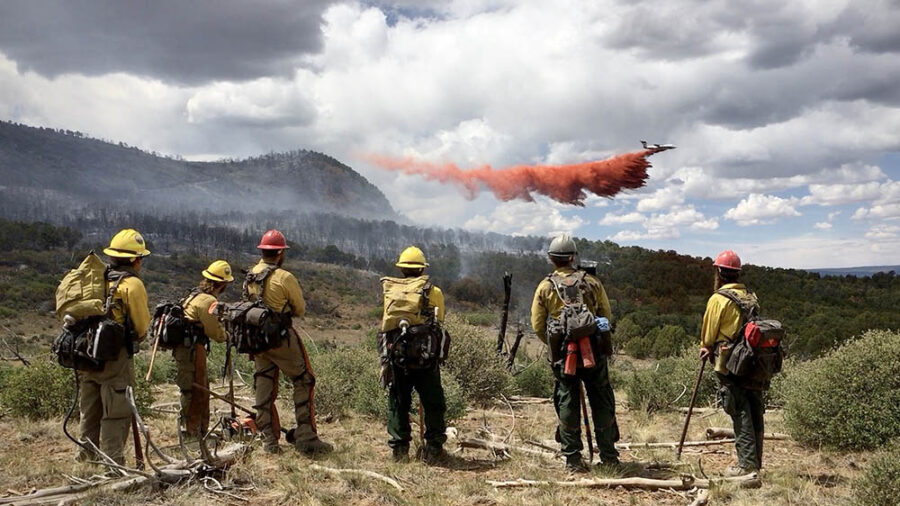
Firefighters observe a retardant drop by an RJ85 air tanker. DOI photo.
Sheehy and Padilla also recently introduced legislation to create a “National Wildfire Intelligence Center” modeled after the National Weather Service to coordinate fire response across federal and state institutions. The Senators called the current system “unnecessarily burdensome,” and said this bill would close gaps in federal response, as multiple agencies currently have their own fire management goals, firefighters, and jurisdictions.
“There is established in the Department of Agriculture, the Department of Commerce, and the Department of the Interior a joint office, to be known as the ‘Wildfire Intelligence Center’…serving as the development and operational center for the comprehensive assessment and prediction of fires that occur in the wildland and fires that move into the built environment to provide decision support services to inform land and fuels management, community outreach and risk reduction, post-wildfire recovery and rehabilitation, and fire management,” the bill’s text read.
Sheehy, before becoming a senator, founded Bridger Aerospace, which operates the largest private Super Scooper fleet in the US, according to its website. He said the acts would streamline resources for wildland fire events.
“We can all agree that the federal government must do a better job protecting our people, property, public lands, and communities from wildfires, and this bill will go a long way in streamlining our wildland firefighting efforts and best leveraging all available resources to accomplish our shared mission,” Sheehy said. “As the only aerial firefighter in the Senate, I’m proud to be working with folks on both sides of the aisle to deliver commonsense solutions to more effectively fight the devastating threat of wildfires and protect the American people.”
Firefighters suppressing the Mosquito Fire off Michigan Bluff Road, Sept. 7, 2022. Credit- Robert Foxworthy, CAL FIRE.
“This new agency would consolidate all wildland fire management responsibilities from the five separate federal land management agencies (US Forest Service, Bureau of Land Management, National Park Service, US Fish and Wildlife Service, and Bureau of Indian Affairs) into a single, cohesive agency,” the advocacy group said. “The new agency should be a comprehensive wildland fire management agency directly under the Department of Homeland Security (DHS) and should be run by experienced wildland fire practitioners and managers. We are optimistic about the discussion this new legislation will generate, but there are few specifics on how it will be implemented.”
The group said the agency’s creation would streamline response to wildfire events, prioritize the safety of wildland firefighters, and efficiently provide cost-savings to American taxpayers.
The “National Wildland Fire Service” bill was referred to the Senate Committee on Agriculture, Nutrition, and Forestry on Feb. 6. The “Wildfire Intelligence Center” bill was referred to the Committee on Agriculture, Nutrition, and Forestry also on Feb. 6.